-
What are businesses seeing?
Continually rising prices for components, energy and global transport are making devices such as sensors, wearables, diagnostics, and remote-monitoring equipment more expensive to produce and procure. Simultaneously, fragile supply chains, especially for specialised medical components, are causing delays, shortages and higher inventory costs.
“Ongoing economic uncertainty, inflation, and supply chain disruptions are significant operational risks for digital health businesses, affecting costs, procurement, and market strategies.”
Carolyn ConnersAgainst this backdrop, it is perhaps not surprising that for the first time in our research, over half of executives (58%) expect their businesses to shrink in the next 12 months.
(Beazley Digital Health & Wellness survey 2026) -
In the early days of digital healthcare during and immediately after COVID-19 in 2020–2021, major central banks pushed interest rates to historic lows, often close to zero, as part of emergency monetary support11. But in 2025, by contrast, inflation stood at 3.6% globally12. Raised inflation levels and higher interest rates place a burden on even the fastest-growing virtual care businesses. Many carry heavy debt loads and must keep hitting financial targets to maintain covenants with lenders – be that traditional banks or venture capital providers.
“Ongoing economic uncertainty, inflation, and supply chain disruptions are significant operational risks for digital health businesses, affecting costs, procurement, and market strategies.”
Evan Smith
Uncertainty, instability and inflation drive risk
These macro-economic pressures are not just features that characterise the external operating environment. Instead, they contribute directly to increased risk exposure. Cost constraints, supply disruptions and operational strains all raise the risk of errors, compliance failures and costly disputes.
As a result, financial and management stress is becoming a key driver of claims risk. It particularly impacts smaller and scaling businesses, those with heavy debt burdens and organisations that failed to anticipate and adapt to changing conditions.
-
Double whammy hits smallest hardest
As supply side pressures bite, inflation and the cost-of-living squeeze are simultaneously suppressing discretionary demand. This ‘double whammy’ hit falls harder on small and mid-sized digital healthcare start-ups and hardware-dependent companies such as remote monitoring, diagnostics, and wearables firms.
-
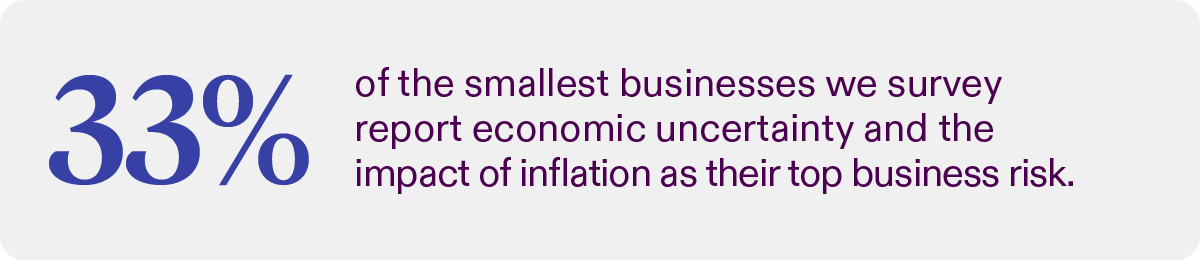
Source: Beazley’s Digital Health & Wellness Survey 2026.
Outcomes are polarised
In this tough and unpredictable operating environment, pressure has not affected every business in the same way.
“There's been a lot of competition over the last five to six years. Those who developed niches are doing well; those that tried to be everything to everyone, spent too much money and grew too fast, are hurting now.”
Evan Smith